The cost of minting NFTs has long been a barrier to mass adoption. On Ethereum, minting 1 million NFTs would cost around $250,000 in gas fees. On Solana's standard implementation, it would still run about $24,000. Enter compressed NFTs (cNFTs) — a breakthrough that brings the cost down to just $110.
What Are Compressed NFTs?
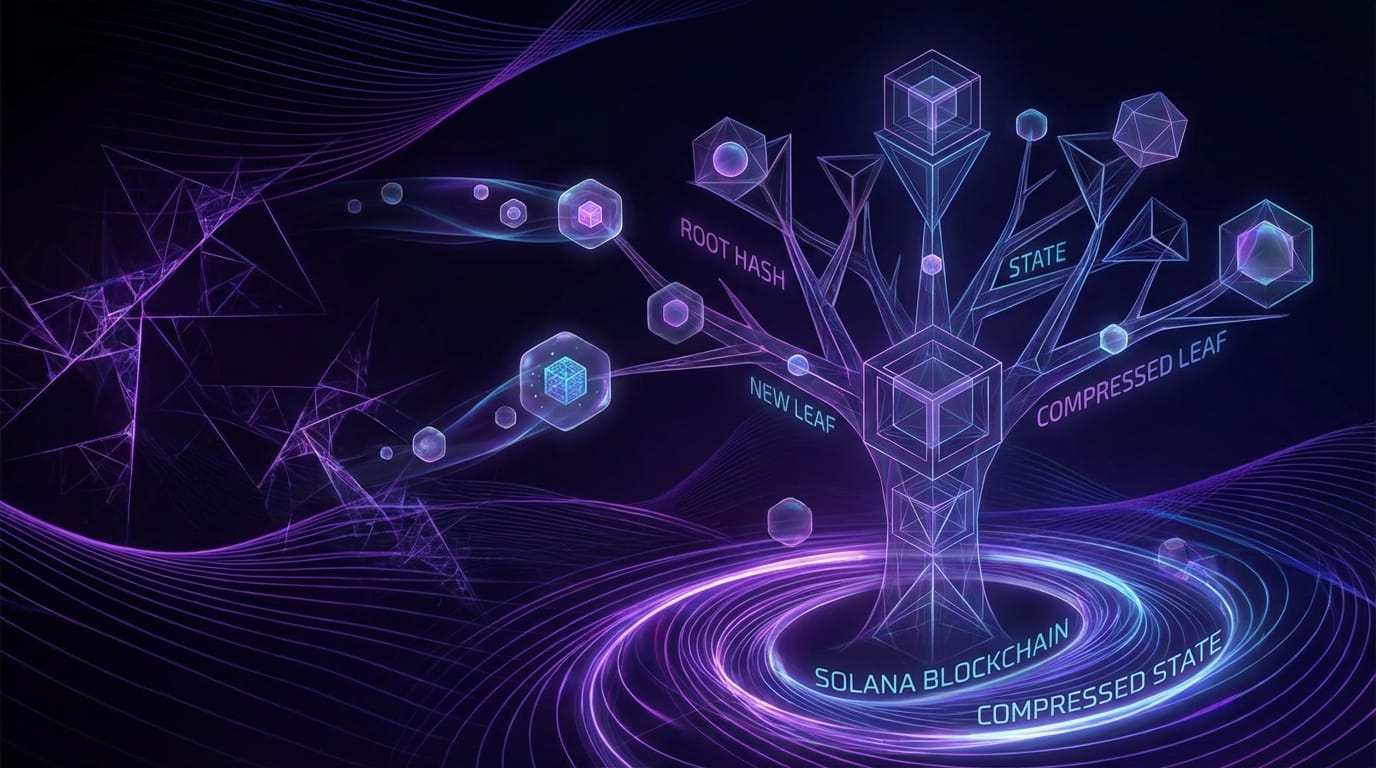
Compressed NFTs leverage Solana's state compression technology to drastically reduce the on-chain data footprint of NFTs. Instead of storing each NFT's metadata directly on-chain (which costs rent in Solana's account model), cNFTs use a clever combination of Merkle trees and concurrent Merkle trees to store only cryptographic proofs on-chain.
Here's how it works: The actual NFT data is stored off-chain (typically on Arweave or another decentralized storage solution), while on-chain, Solana stores only a Merkle root — a single hash representing the entire tree of NFTs. When you need to prove ownership or transfer a cNFT, you provide a Merkle proof that verifies your NFT exists in the tree without requiring every NFT's data to be stored on-chain.
The Cost Breakthrough
The economics are staggering. With standard Solana NFTs, each token requires creating a new account, which costs about 0.012 SOL in rent. For 1 million NFTs at $150/SOL, that's $24,000. But with cNFTs, you're only paying to update the Merkle tree, which costs roughly $110 for the same 1 million NFTs — a 99.5% reduction.
This isn't theoretical. Projects are already leveraging cNFTs at massive scale:
- DRiP: The digital collectibles platform has distributed over 100 million cNFTs to users, making it one of the largest NFT projects by volume.
- Helium: Uses cNFTs to represent hotspot location assertions and data transfer records at scale.
- Crossmint: Enables enterprise clients to mint millions of NFTs for loyalty programs and digital credentials.
Use Cases Unlocked
The dramatic cost reduction opens entirely new categories of NFT applications that were previously economically infeasible:
- Gaming In-Game Assets: Games can now mint every sword, potion, and cosmetic item as an NFT without worrying about cost. A game with 1 million players receiving 100 items each? That's 100 million NFTs for just $11,000 using cNFTs.
- Loyalty and Rewards Programs: Brands can issue NFT-based loyalty points, tickets, or membership credentials to millions of customers. Starbucks could give every customer an NFT receipt for every purchase without breaking the bank.
- Digital Credentials and Certificates: Educational institutions can issue diplomas, course completion certificates, and badges as verifiable NFTs. Professional certifications become portable and instantly verifiable.
- Event Ticketing: Concert venues, sports stadiums, and conferences can issue NFT tickets with dynamic attributes (VIP access, merchandise discounts, collectible value) without worrying about minting costs per attendee.
- Social Media and Content: Every post, comment, or interaction could be an NFT, creating provable digital history and enabling new creator monetization models.
Technical Deep Dive: How State Compression Works
Solana's state compression uses concurrent Merkle trees, which allow multiple users to modify the tree simultaneously without conflicts. The key innovation is separating the tree's structure (stored on-chain as a single account) from the leaf data (stored off-chain).
When you create a cNFT collection, you're essentially creating a Merkle tree with a maximum capacity (typically 16,384 or 1,048,576 leaves). Each leaf represents one NFT. The tree parameters determine your storage costs:
- Max depth: Determines maximum capacity (2^depth). Depth 20 = ~1M NFTs.
- Max buffer size: Controls how many concurrent changes the tree can handle. Higher buffer = more concurrent minting but higher storage cost.
- Canopy depth: Caches upper tree layers on-chain, reducing proof size for transfers. Higher canopy = cheaper transfers but higher initial cost.
The Trade-offs
cNFTs aren't without compromises. Understanding these trade-offs is crucial for builders:
- Proof Requirements: Every operation (transfer, burn, update) requires a Merkle proof. This means indexers must track the tree state, and wallets/dApps need access to these proofs. Services like Helius and SimpleHash provide APIs for this.
- Composability: cNFTs can't be used as easily in all DeFi protocols since they don't have traditional token accounts. Projects need to specifically add cNFT support.
- Metadata Updates: While possible, updating metadata is more complex than with standard NFTs since you're modifying the Merkle tree structure.
- Wallet Support: Not all Solana wallets fully support cNFTs yet, though major wallets like Phantom and Backpack have added support.
However, the infrastructure is maturing rapidly. The Metaplex Bubblegum program (the standard for cNFTs) is battle-tested, and RPC providers now offer dedicated cNFT indexing services.
Getting Started with cNFTs
For developers looking to implement cNFTs, the ecosystem offers several entry points:
- Metaplex: Provides SDKs and tools for minting, transferring, and managing cNFTs. Their Bubblegum program is the standard implementation.
- Crossmint: Offers enterprise-grade APIs for cNFT minting and management with credit card payments and custodial solutions.
- Helius: Provides RPC infrastructure optimized for cNFTs, including indexing and proof generation services.
- Underdog Protocol: Simple REST APIs for creating and managing cNFT projects without deep blockchain knowledge.
The Future of Digital Assets
Compressed NFTs represent a fundamental shift in how we think about digital ownership at scale. By reducing costs by 99.5%, they don't just make existing use cases cheaper — they enable entirely new categories of applications that were previously impossible.
We're already seeing this play out. DRiP has onboarded millions of users who would never pay for traditional NFTs. Games are experimenting with true item ownership without prohibitive costs. Enterprises are exploring blockchain-based loyalty programs that were economically infeasible before.
As the infrastructure matures and more wallets, marketplaces, and protocols add support, compressed NFTs will likely become the default for high-volume NFT applications. The question isn't whether cNFTs will be adopted — it's which groundbreaking applications they'll enable next.
When minting 1 million NFTs costs less than a nice dinner, the only limit is imagination.