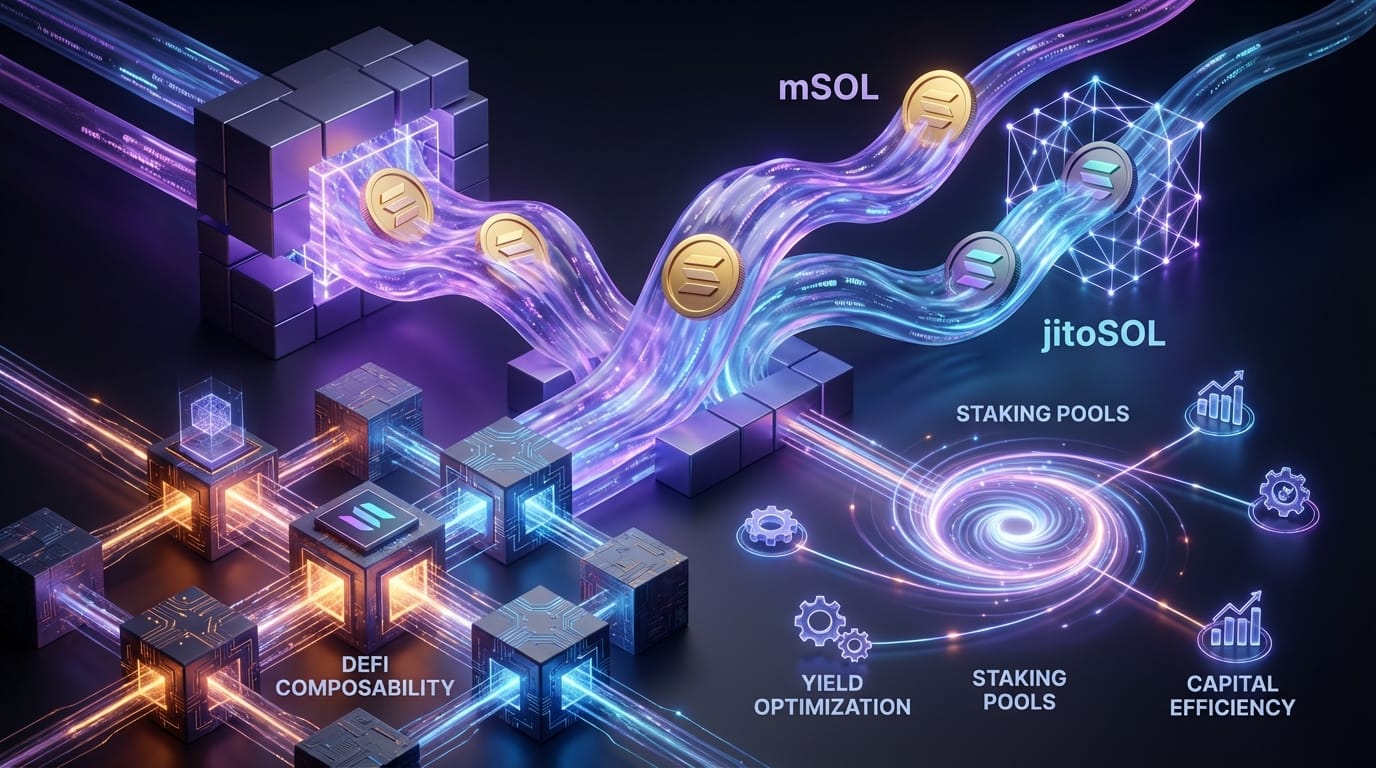
Staking your SOL doesn't have to mean choosing between security and flexibility. Liquid staking protocols on Solana let you earn staking rewards while maintaining the ability to trade, lend, or use your tokens in DeFi—unlocking capital efficiency that traditional staking can't match.
The Traditional Staking Dilemma
When you stake SOL directly with a validator, you're contributing to network security and earning rewards—but your tokens are locked. You can't trade them, use them as collateral, or deploy them in DeFi strategies. With Solana's multi-day unstaking period, accessing your capital requires planning ahead.
This creates an opportunity cost. While approximately 65% of SOL is staked (securing the network), holders face a choice: earn staking rewards or maintain liquidity for DeFi opportunities. Liquid staking eliminates this trade-off entirely.
How Liquid Staking Works
Liquid staking protocols accept your SOL deposits and stake them across a diversified set of validators. In return, you receive a liquid staking token (LST) that represents your staked SOL plus accrued rewards. This LST can be freely traded, transferred, or used in DeFi while continuing to earn staking yield.
The magic is in the token's value appreciation. Your LST gradually increases in value relative to SOL as staking rewards accumulate. For example, if you deposit 100 SOL and receive 100 mSOL, after a year that mSOL might be redeemable for 107 SOL (assuming ~7% APY)—all while you were using it elsewhere.
Marinade Finance: The Liquid Staking Pioneer
Marinade Finance pioneered liquid staking on Solana, managing over $1 billion in TVL at its peak. When you stake SOL with Marinade, you receive mSOL—a token that's become one of the most widely integrated LSTs in the Solana DeFi ecosystem.
Key features of Marinade:
- Automated validator selection: Your stake is distributed across 100+ validators using a delegation strategy that optimizes for decentralization and performance.
- Instant unstake option: Need your SOL immediately? Use Marinade's liquidity pool to swap mSOL back to SOL instantly, paying a small fee instead of waiting through the unstaking period.
- DeFi integration: mSOL is accepted as collateral on lending platforms like Solend and MarginFi, tradeable on DEXs, and usable in liquidity pools across the ecosystem.
Marinade also contributed to network decentralization by directing stake to smaller, high-performing validators that might otherwise struggle to attract delegations—strengthening Solana's censorship resistance.
Jito: MEV-Enhanced Staking
Jito takes liquid staking further by capturing MEV (Maximal Extractable Value) and redistributing it to stakers. When you stake SOL with Jito, you receive jitoSOL and earn enhanced yields from both traditional staking rewards and MEV profits.
MEV occurs when validators reorder, include, or exclude transactions to capture additional profit—think arbitrage opportunities or liquidations. Rather than letting validators pocket all this value, Jito's infrastructure shares MEV revenue with jitoSOL holders, typically adding 1-2% extra APY on top of base staking rewards.
Why Jito's approach matters:
- Higher yields: jitoSOL consistently offers higher APY than standard staking by sharing MEV profits that would otherwise go entirely to validators.
- MEV democratization: Instead of concentrating MEV profits with a small group of sophisticated validators, Jito distributes them to all jitoSOL holders proportionally.
- Growing ecosystem: Like mSOL, jitoSOL is widely integrated across DeFi protocols, accepted as collateral, and tradeable on major DEXs.
Jito has grown rapidly, managing over $2 billion in TVL and becoming one of the largest liquid staking protocols on Solana. Their validator network processes a significant portion of Solana's transactions, maximizing MEV capture opportunities.
Unlocking DeFi Composability
The true power of liquid staking emerges when you start composing yield strategies. Here's how DeFi users leverage LSTs:
- Lending collateral: Deposit mSOL or jitoSOL as collateral on Solend or MarginFi, borrow stablecoins, and deploy that capital elsewhere—all while your staked SOL continues earning rewards.
- Liquidity provision: Provide mSOL-SOL or jitoSOL-USDC liquidity on AMMs like Orca or Raydium. Earn trading fees and liquidity mining rewards on top of your staking yield.
- Leveraged staking: Sophisticated users can borrow against their LSTs to acquire more SOL, stake it for more LSTs, and repeat—creating leveraged exposure to staking yields (with corresponding liquidation risks).
- Trading strategies: Trade mSOL or jitoSOL on DEXs without unstaking. If you believe SOL is overvalued short-term but want to maintain long-term staking exposure, swap your LST to stables, then swap back later.
This composability transforms idle staked capital into productive DeFi assets. Users who once faced a binary choice—stake or use in DeFi—can now do both simultaneously, maximizing capital efficiency.
Understanding the Risks
While liquid staking offers compelling benefits, it introduces additional risk layers:
- Smart contract risk: You're trusting the protocol's smart contracts to handle your SOL securely. While Marinade and Jito have been audited extensively and operated for years without major incidents, smart contract bugs remain a non-zero risk.
- Slashing risk: While Solana doesn't currently implement slashing penalties for validator misbehavior, this could change. Liquid staking protocols typically have insurance mechanisms or reserve funds to protect users, but future slashing implementations could impact LST values.
- Depeg risk: In extreme market conditions or if confidence in a protocol drops, LSTs can trade at a discount to their underlying SOL value. This happened briefly during market stress events, though the peg typically recovers as arbitrageurs step in.
- Liquidity risk: While major LSTs like mSOL and jitoSOL have deep liquidity, instant unstaking relies on available liquidity pools. During extreme events, you might face higher slippage or need to wait through the standard unstaking period.
For most users, these risks are acceptable trade-offs for the capital efficiency and flexibility liquid staking provides. Both Marinade and Jito have established track records, transparent operations, and strong security practices that minimize risk exposure.
The Future of Liquid Staking on Solana
Liquid staking adoption on Solana continues accelerating. As more DeFi protocols integrate LSTs as collateral and liquidity grows deeper, the capital efficiency benefits become increasingly compelling. Several trends are shaping the ecosystem's evolution:
- Native protocol integration: More DeFi protocols are building native support for LSTs, treating them as first-class assets rather than wrapped alternatives to SOL.
- Institutional adoption: As institutional capital flows into Solana, liquid staking provides the capital efficiency and liquidity these players demand. Expect institutional-grade liquid staking solutions to emerge.
- LST standards: The ecosystem is converging on standards for LST behavior, making it easier for DeFi protocols to integrate multiple liquid staking tokens uniformly.
- Cross-chain LSTs: Bridging solutions are bringing Solana LSTs to other chains, allowing mSOL and jitoSOL to be used in Ethereum DeFi, expanding their utility beyond Solana's ecosystem.
The competition between liquid staking protocols also drives innovation. Marinade's focus on decentralization, Jito's MEV-enhanced yields, and newer entrants exploring different value propositions create a diverse ecosystem where users can choose protocols matching their preferences.
Getting Started with Liquid Staking
Ready to put your SOL to work? Here's how to start:
- For Marinade: Visit marinade.finance, connect your Solana wallet, and stake SOL to receive mSOL. The process is instant, and you'll start earning rewards immediately.
- For Jito: Head to jito.network, connect your wallet, and stake SOL to receive jitoSOL. MEV rewards are automatically compounded into your jitoSOL value.
Once you hold mSOL or jitoSOL, explore DeFi opportunities on platforms like Solend for lending, Orca for liquidity provision, or Jupiter for swapping. Your LST continues earning staking rewards while deployed in these strategies, creating compounding yield opportunities that traditional staking can't match.
Liquid staking represents a fundamental evolution in how we think about staked assets. By removing the liquidity constraint, protocols like Marinade and Jito have unlocked billions in capital efficiency, strengthened network decentralization, and enabled sophisticated DeFi strategies—all while maintaining the security benefits of traditional staking. For Solana holders balancing security, yield, and flexibility, liquid staking offers the best of all worlds.