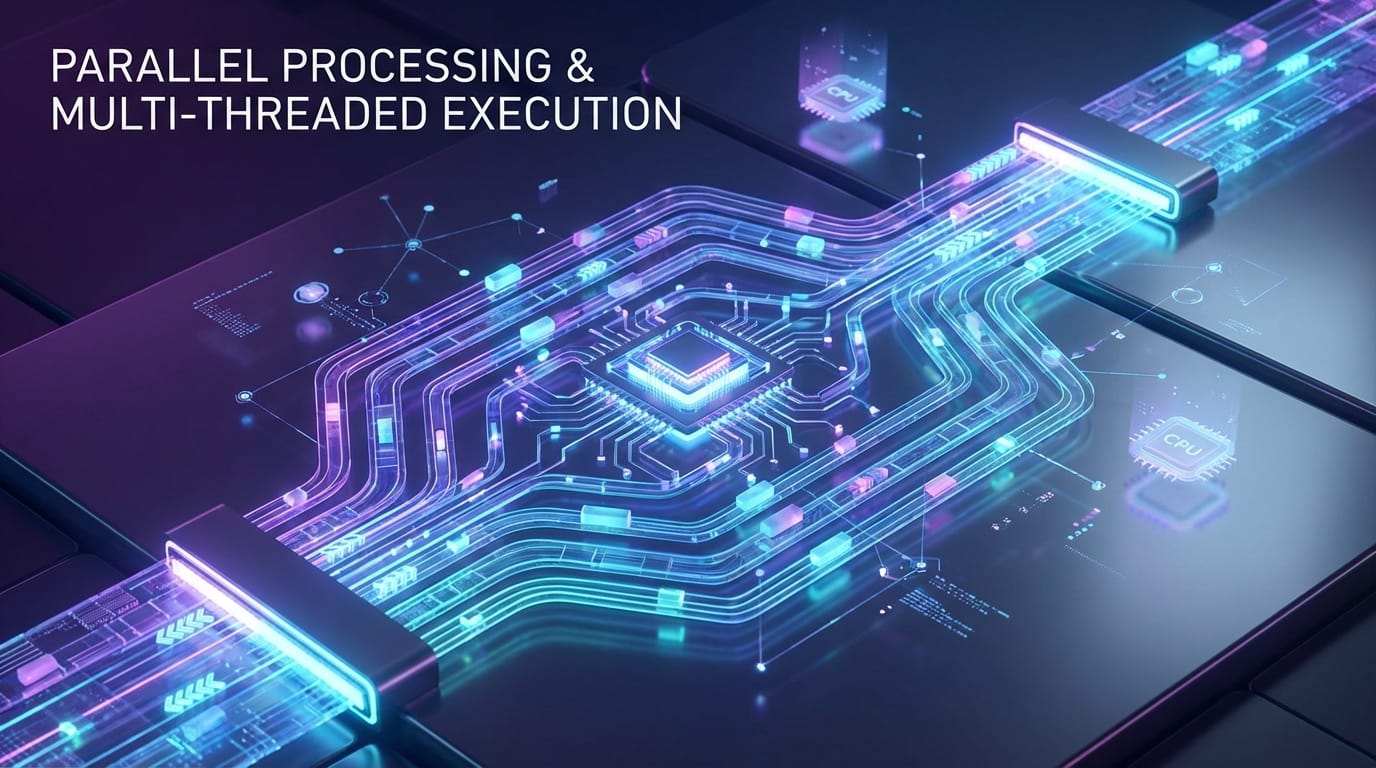
While most blockchains process transactions sequentially—like a single-lane highway—Solana's Sealevel runtime operates more like a multi-lane expressway, processing thousands of transactions simultaneously. This fundamental architectural difference is why Solana can achieve 50,000+ transactions per second while maintaining low fees and sub-second finality.
The Sequential Bottleneck
Traditional blockchain runtimes like the Ethereum Virtual Machine (EVM) process transactions one at a time. Even if two transactions are completely independent—say, Alice sending tokens to Bob while Carol mints an NFT—they must wait in line for sequential execution.
This design made sense when blockchains ran on single-core processors. But modern hardware has 16, 32, or even 128 cores sitting idle while blockchain software uses just one. It's like hiring a construction crew of 50 workers but only allowing one person to work at a time.
Sealevel's Parallel Execution Model
Sealevel is Solana's parallel smart contract runtime—the world's first parallelized EVM-compatible execution environment. The name is a playful reference to SeaWorld (Solana) being deeper than the EVM's "sea level."
The key innovation: Solana transactions explicitly declare which accounts (state) they will read from and write to before execution. This is fundamentally different from EVM transactions, which can touch any state they want during execution.
Here's how it works:
- Account Declaration: Every transaction lists all accounts it needs, marking each as readable or writable
- Dependency Analysis: The scheduler identifies which transactions are independent (no overlapping writable accounts)
- Parallel Dispatch: Independent transactions are routed to different CPU cores for simultaneous execution
- State Updates: Results are collected and state changes are applied atomically
Real-World Performance
The impact of parallel execution is dramatic. On a 128-core machine:
- Non-overlapping transactions (different token transfers, NFT mints) execute with near-perfect parallelization—128x faster than sequential execution
- DEX trades for different pairs run in parallel—Raydium SOL/USDC and Orca RAY/USDT swaps don't wait for each other
- NFT marketplace activity scales horizontally—Magic Eden can process hundreds of listings and sales simultaneously
Even transactions that touch the same accounts benefit. When 100 people try to buy from the same liquidity pool, Sealevel optimistically executes all trades in parallel, then resolves conflicts deterministically. This speculative execution means even contentious operations are faster than sequential processing.
The Developer Experience
For developers, Sealevel's architecture means thinking differently about program design:
- Account-based architecture: Instead of global storage like Ethereum contracts, Solana programs explicitly work with passed-in accounts
- Composability constraints: Cross-program invocations must declare their account dependencies upfront
- Parallel-friendly patterns: Avoiding global counters and shared bottlenecks enables maximum throughput
This explicit dependency model is initially more verbose than EVM development, but it unlocks performance that's simply impossible with implicit state access. As the saying goes: "Make dependencies explicit, execution parallel."
Why This Matters
Sealevel's parallel execution isn't just about raw speed—it's about enabling use cases that are economically infeasible on sequential blockchains:
- High-frequency trading: Sub-second finality + parallel execution = viable on-chain orderbooks
- Gaming: Thousands of players interacting with different game objects simultaneously without congestion
- DePIN networks: Millions of IoT devices submitting telemetry and earning rewards in parallel
- Mass airdrops: Distributing tokens to millions of users in minutes, not hours or days
When fees stay below $0.0001 even during peak demand, entirely new categories of applications become possible.
The Future of Parallel Execution
Sealevel continues to evolve. Recent improvements include:
- BPF JIT compilation optimizations reducing per-instruction overhead
- Better scheduler heuristics for predicting and avoiding contention
- Adaptive batching that dynamically adjusts parallelization based on workload characteristics
As hardware continues to scale—with 256-core and 512-core processors on the horizon—Sealevel's architecture ensures Solana can take full advantage of these improvements without fundamental redesigns.
While other blockchains explore sharding or layer-2 solutions to scale, Solana's approach is more fundamental: make the base layer fast enough that you don't need workarounds. Sealevel proves that with the right architectural decisions, a single-chain design can deliver the throughput needed for mainstream adoption.