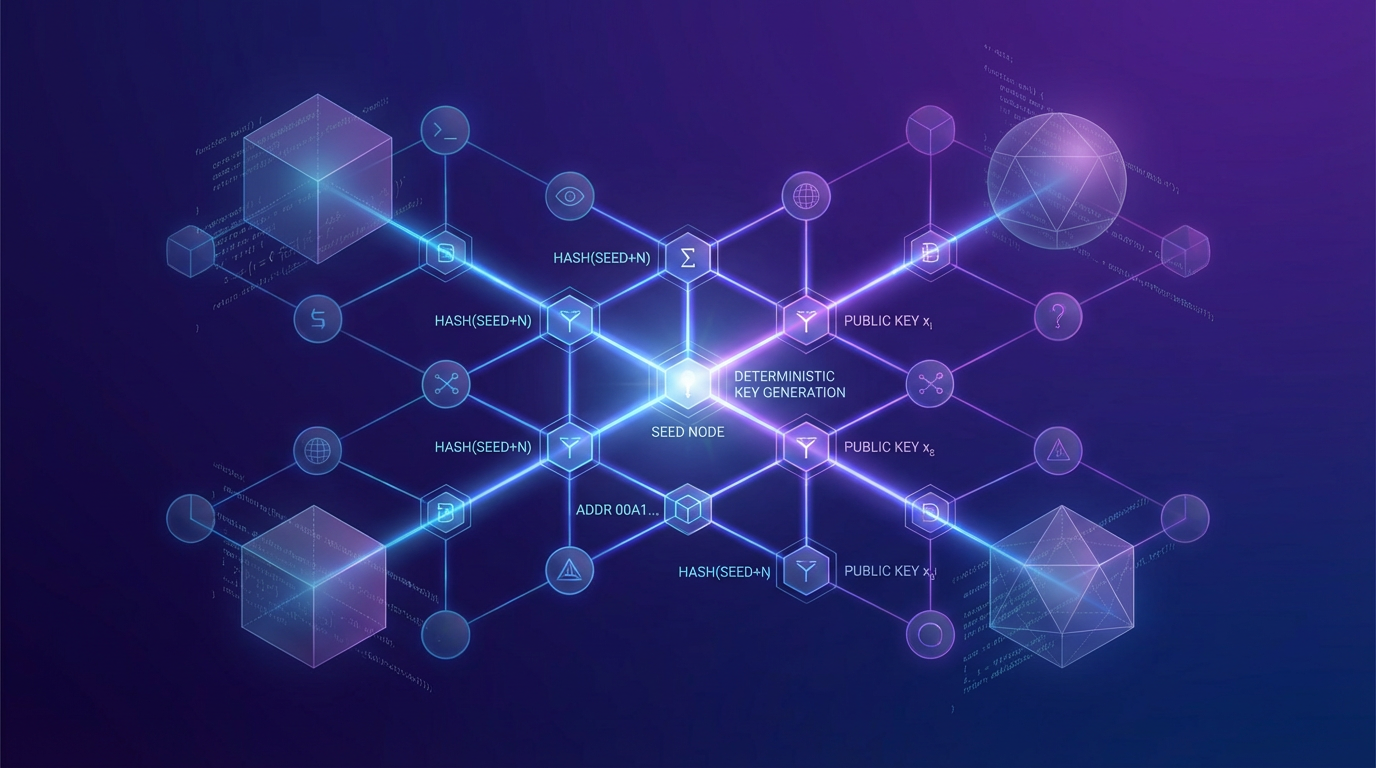
When building programs on Solana, one of the most powerful primitives you'll encounter is the Program Derived Address (PDA). Unlike traditional accounts that are controlled by private keys, PDAs are special addresses that programs can sign for - enabling deterministic, ownerless accounts that unlock sophisticated design patterns.
What Are Program Derived Addresses?
A PDA is an account address that is derived deterministically from a program ID and a set of seeds. The key characteristic: PDAs are addresses that intentionally fall off the Ed25519 elliptic curve, meaning no corresponding private key exists. Only the program that derived the PDA can sign transactions on its behalf.
This solves a fundamental problem in blockchain development: how do you create accounts that programs can control without requiring external signatures? On Ethereum, this led to complex contract factory patterns. On Solana, PDAs provide an elegant solution.
How PDAs Work: The Mechanics
PDAs are generated using the find_program_address function, which takes two inputs:
1. Seeds: An array of byte arrays (typically including strings, public keys, or other identifiers)
2. Program ID: The address of the program deriving the PDA
The function works by hashing these inputs with SHA256 and checking if the resulting address has a corresponding private key. If it does, a bump seed (starting at 255 and counting down) is appended until an address without a private key is found.
Why PDAs Matter: Key Use Cases
Deterministic Account Creation
PDAs enable predictable account addresses. If you know the seeds and program ID, you can derive the exact address without any on-chain lookup. This is crucial for building scalable applications where clients need to find accounts without querying the blockchain.
Program-Controlled Accounts
Since only the program can sign for its PDAs, they act as program-controlled wallets. This enables patterns like escrow systems, vaults, and token custody without requiring multisig complexity.
Common Design Patterns
Associated Token Accounts: The most familiar PDA pattern. Every wallet's token account for a specific mint is a PDA derived from the wallet address and mint address.
Global State Accounts: Programs use PDAs with constant seeds to store global configuration, creating singleton patterns without hardcoded addresses.
Escrow and Vaults: PDAs hold assets and release them when program conditions are met. DeFi protocols extensively use this for liquidity pools and lending markets.
Best Practices
Cache the Bump Seed: Computing PDAs is expensive (~1,000 compute units). Store the bump seed when creating accounts.
Seed Collision Prevention: Choose structured seeds carefully to avoid collisions and maintain code clarity.
Security Verification: Always verify PDA ownership in your program logic. Check that derived addresses match provided accounts.
As you build on Solana, mastering PDAs transitions from understanding a feature to recognizing them as the foundation of elegant program design. They're not just a technical detail—they're a paradigm shift in how blockchain applications manage state and identity.