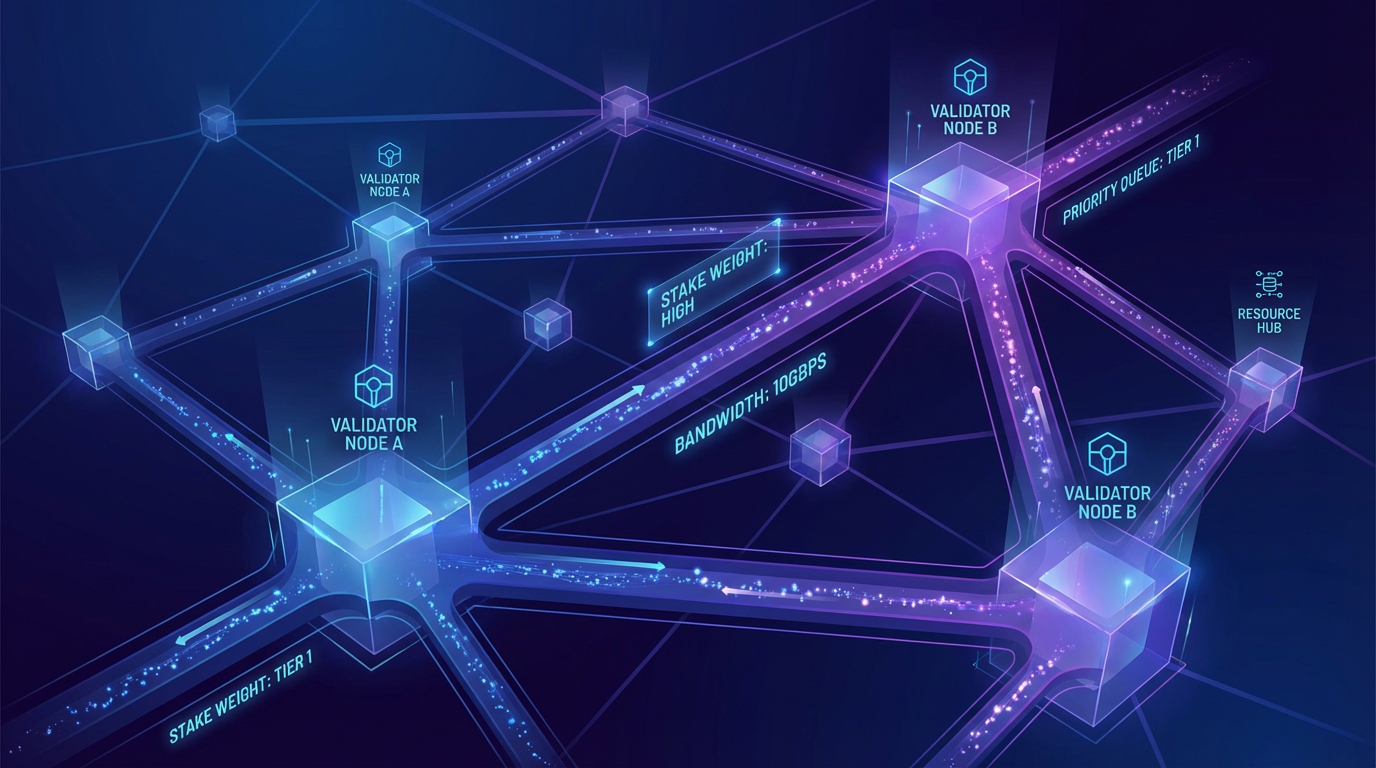
In a high-throughput network like Solana, managing scarce network resources fairly across thousands of validators is critical. Stake-weighted Quality of Service (QoS) is Solana's elegant solution to bandwidth allocation, transaction forwarding, and DoS prevention—ensuring that validators with more economic stake receive proportional access to network capacity.
This post explores how stake-weighted QoS works, why it matters for network stability, and how it impacts validator operations and transaction propagation.
The Resource Allocation Challenge
Solana validators operate in a peer-to-peer network where they constantly exchange data: transactions, votes, blocks, and shreds. With over 1,900 validators and network bandwidth being finite, the system needs rules for who gets priority when resources are constrained.
Without proper allocation mechanisms:
- Malicious actors could flood the network with fake validators (Sybil attack)
- Low-stake validators could consume disproportionate bandwidth
- High-stake validators critical for consensus might get starved
- Transaction propagation could become unreliable
Stake-weighted QoS solves this by tying network resource allocation directly to validator stake—creating economic alignment between network participation and resource consumption.
How Stake-Weighted QoS Works
The core principle is simple: validators receive network bandwidth proportional to their stake weight in the network. If a validator controls 1% of total stake, they receive approximately 1% of available bandwidth for forwarding transactions and blocks.
Connection Limits
Each validator maintains a limited number of peer connections. Stake-weighted QoS influences which peers get accepted:
High-stake validators are prioritized for peer connections
Low-stake validators may get rate-limited or deprioritized
Zero-stake nodes (RPC endpoints) receive minimal QoS
Packet Forwarding Priority
When forwarding transactions to the current leader, validators use stake-weighted prioritization:
- Leaders allocate bandwidth to incoming transactions based on sender stake
- Higher-stake validators' transactions are less likely to be dropped during congestion
- This ensures critical consensus messages (votes) reach leaders reliably
Bandwidth Quotas
The system enforces per-validator bandwidth quotas for both inbound and outbound traffic. These quotas scale with stake: