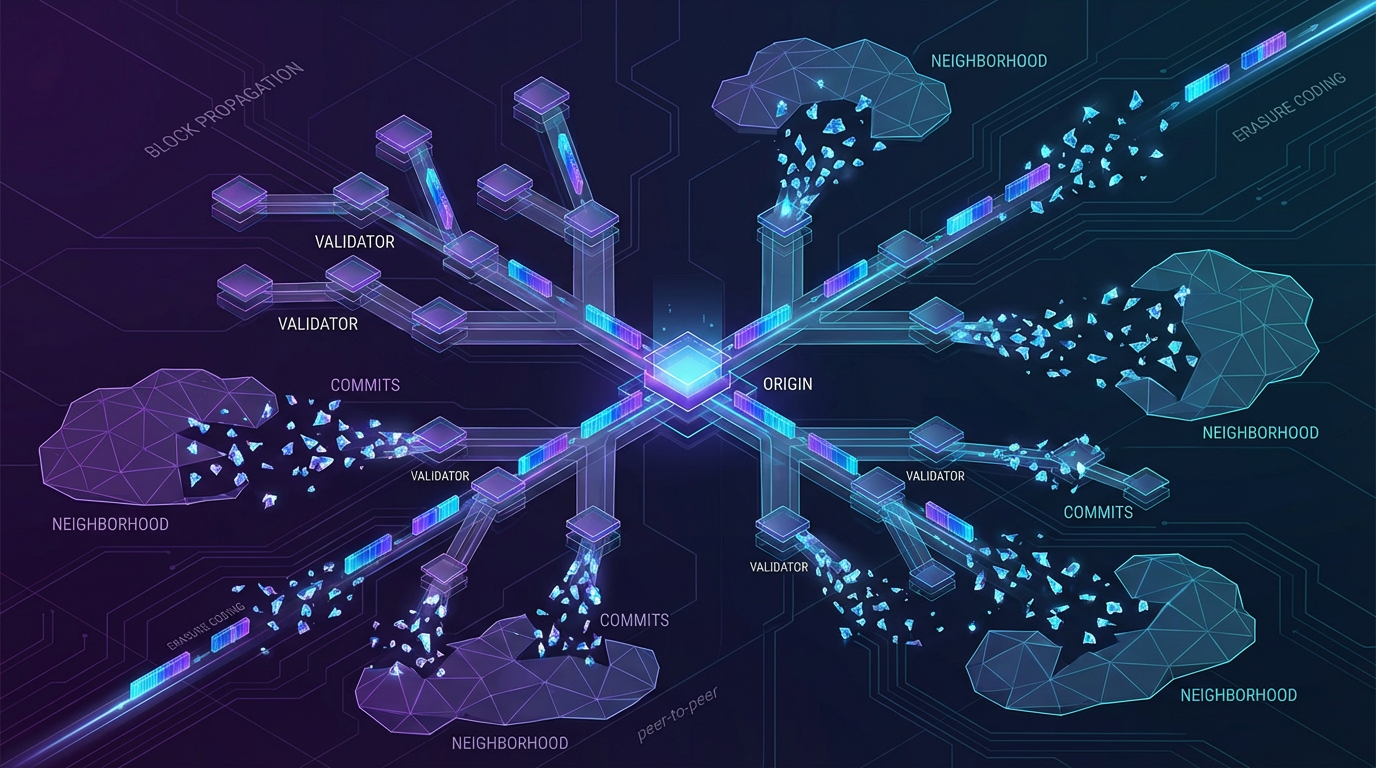
One of Solana's most impressive engineering achievements is its ability to propagate blocks across thousands of validators in a fraction of a second. This feat is made possible by Turbine, a block propagation protocol that borrows concepts from peer-to-peer file sharing networks like BitTorrent. In this post, we'll explore how Turbine works, why it's critical for Solana's performance, and how it enables the network's remarkable throughput.
The Block Propagation Challenge
In traditional blockchain networks, when a validator produces a block, it must send that entire block to every other validator. This creates bandwidth bottlenecks—if a validator has limited upload capacity and must send a 100MB block to 1,000 other validators, propagation becomes painfully slow. The math is simple but brutal: sending 100MB to 1,000 nodes requires 100GB of upload bandwidth.
For networks targeting high throughput, this becomes the primary scaling bottleneck. Solana's blocks are larger than most blockchains because they pack in thousands of transactions per second. Without an efficient propagation mechanism, the network would grind to a halt as validators struggled to share block data.
How Turbine Works
Turbine solves the bandwidth problem by treating block propagation like a peer-to-peer file download. Instead of the leader sending the full block to every validator, Turbine breaks blocks into small packets (called "shreds") and distributes them across the network in a hierarchical tree structure.
Step 1: Shredding the Block
The current leader (the validator responsible for producing the current block) breaks the block into packets of approximately 1,280 bytes each. These packets are called "shreds." Each shred is cryptographically signed to prevent tampering and includes metadata indicating which block it belongs to and its position within that block.
Turbine also applies erasure coding to the shreds. Erasure coding is a technique borrowed from storage systems that allows the original data to be reconstructed even if some packets are lost. For example, with erasure coding, you might create 150 shreds where only 100 are needed to reconstruct the block. This provides redundancy—if 50 shreds are lost due to network issues, validators can still rebuild the full block.
Step 2: Organizing Validators into Neighborhoods
Turbine organizes validators into a hierarchical tree structure with multiple layers. The leader sits at the top, and validators are grouped into "neighborhoods" at each layer. The size of these neighborhoods is carefully chosen to balance bandwidth usage and propagation speed.
Here's how the hierarchy works:
- Layer 0 (Leader): The leader sends different shreds to a small number of validators in Layer 1 (typically around 200 validators).
- Layer 1: Each validator in Layer 1 receives a subset of shreds and forwards them to validators in Layer 2 within their designated neighborhood.
- Layer 2 and beyond: This pattern continues, with each validator forwarding shreds to the next layer until all validators have received enough shreds to reconstruct the block.
The key insight is that each validator only needs to send data to a small number of peers (its neighborhood), rather than the entire network. This dramatically reduces the bandwidth burden on any single node.
Step 3: Reconstructing the Block
Once a validator has collected enough shreds (thanks to erasure coding, it doesn't need all of them), it can reconstruct the full block. The validator verifies the cryptographic signatures on each shred to ensure they came from the legitimate leader and haven't been tampered with.
After reconstruction, the validator processes the transactions in the block and updates its local state accordingly. This entire process—from the leader producing the block to validators around the world receiving and reconstructing it—typically takes only 200-400 milliseconds.
Why Turbine Matters for Performance
Turbine's efficiency is what allows Solana to achieve its impressive performance characteristics:
- Logarithmic Scaling: With Turbine, the time to propagate a block grows logarithmically with the number of validators. Adding more validators to the network has minimal impact on propagation time because each new validator only needs to communicate with a small neighborhood.
- Bandwidth Efficiency: Instead of the leader needing gigabits of upload bandwidth to serve every validator, it only needs to send data to Layer 1 validators. The bandwidth load is distributed across the entire network, making it feasible for validators with moderate hardware to participate.
- Fault Tolerance: Erasure coding ensures that even if some shreds are lost due to network issues or malicious validators, the block can still be reconstructed. This makes the system resilient to temporary outages and adversarial behavior.
- Sub-Second Finality: Fast block propagation is a prerequisite for Solana's 400ms slot time. If blocks took several seconds to propagate, the network couldn't maintain its rapid cadence of block production and voting.
Turbine in Action: A Real-World Example
Let's walk through a concrete example with realistic numbers:
- Solana has approximately 1,500 validators
- A typical block might contain 3,000 transactions and be around 1.5MB in size
- This block is shredded into approximately 1,200 packets of 1,280 bytes each
- Erasure coding adds redundancy, creating 1,800 total shreds (33% overhead for fault tolerance)
- Validators are organized into a tree with neighborhood size of 200
- The tree has 3 layers: Leader → 200 validators (Layer 1) → 1,300 validators (Layer 2)
The leader sends 1,800 shreds to 200 Layer 1 validators—each Layer 1 validator receives approximately 9 shreds. These Layer 1 validators then forward shreds to their neighborhoods in Layer 2. Within approximately 200-300 milliseconds, all 1,500 validators have enough shreds to reconstruct the full block.
Compare this to a naive approach where the leader sends the full 1.5MB block to all 1,500 validators—that would require 2.25GB of upload bandwidth and take significantly longer even with a high-bandwidth connection.
Optimizations and Trade-offs
Turbine involves several design choices that balance performance and reliability:
- Neighborhood Size: Larger neighborhoods mean fewer layers (faster propagation) but higher bandwidth per node. Smaller neighborhoods reduce per-node bandwidth but add more layers (slower propagation). Solana's choice of ~200 validators per neighborhood strikes a balance optimized for current network conditions.
- Erasure Coding Overhead: Adding 33% redundancy increases total data transmitted but provides crucial fault tolerance. Without it, a single lost packet could prevent block reconstruction, requiring expensive retransmissions.
- Stake Weighting: Validators with more stake are strategically placed in the tree to receive and forward shreds first. This ensures that the most economically important validators (those with the most voting power) can reconstruct blocks quickly and vote on them without delay.
- UDP vs TCP: Turbine uses UDP (User Datagram Protocol) rather than TCP because UDP has lower latency and doesn't require acknowledgment handshakes. Combined with erasure coding, this provides speed without sacrificing reliability.
Practical Implications for Developers
While Turbine operates transparently at the protocol layer, understanding it helps developers appreciate Solana's performance characteristics:
- Expect Fast Confirmation: Because blocks propagate so quickly, your transactions can achieve confirmation in under a second. This enables real-time user experiences that would be impossible on slower chains.
- Network Resilience: Turbine's fault tolerance means your transactions won't be delayed by transient network issues affecting individual validators. The network self-heals around packet loss.
- Scalability Headroom: As Solana's validator set grows, Turbine ensures propagation time increases only logarithmically. This means the network can support thousands more validators without degrading performance, providing long-term decentralization scalability.
Conclusion
Turbine is a masterclass in distributed systems engineering. By borrowing ideas from BitTorrent and combining them with erasure coding, hierarchical organization, and stake weighting, Solana achieves block propagation speeds that were previously thought impossible at this scale.
This protocol is foundational to Solana's value proposition: delivering high throughput without sacrificing decentralization. While users and developers rarely think about Turbine directly, it's working behind the scenes in every slot, ensuring that thousands of transactions reach global consensus in a fraction of a second.
Understanding Turbine gives you insight into why Solana feels different from other blockchains—it's not just about raw computational power, but about intelligent protocol design that makes efficient use of every validator's resources. As Solana continues to evolve, Turbine will remain a critical piece of infrastructure enabling the network to scale to millions of transactions per second.