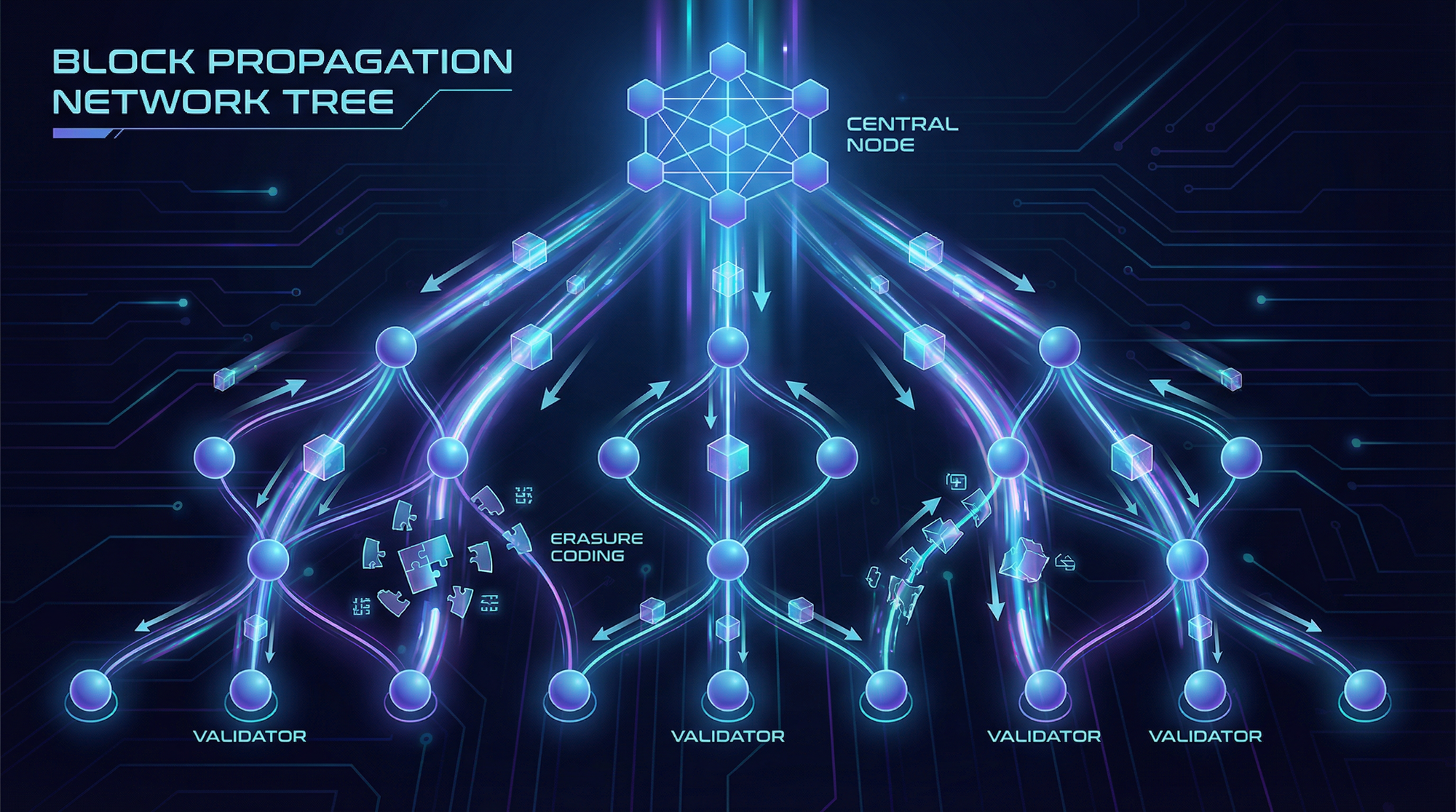
In traditional blockchain architectures, broadcasting blocks to thousands of validators creates a fundamental bottleneck. As validator counts grow, network bandwidth requirements increase exponentially—making true decentralization technically impractical. Solana solves this problem with Turbine, an innovative block propagation protocol inspired by BitTorrent that enables the network to reach over 1,000 validators while maintaining sub-second confirmation times.
The Block Propagation Challenge
When a leader produces a new block in Solana, that block must reach every validator in the network for consensus. With blocks generated every 400ms and containing up to 48 million compute units worth of transactions, the data volume is substantial. A naive approach of broadcasting the full block to every validator would require the leader to have bandwidth proportional to the number of validators—creating a centralization pressure where only entities with massive network infrastructure could serve as leaders.
This is where Turbine's elegant solution comes into play.
How Turbine Works: Breaking Blocks into Shreds
Turbine breaks each block into small packets called "shreds" (typically 1KB each). But rather than simply fragmenting the data, Turbine applies Reed-Solomon erasure coding—the same technology used in RAID storage systems and QR codes. This creates redundancy: if a block is broken into 100 shreds, erasure coding might generate 167 total shreds where any 100 of them can reconstruct the complete block.
This erasure coding provides two critical benefits:
- Fault tolerance: Network packet loss doesn't prevent block reconstruction. Validators only need to receive 60% of shreds to rebuild the full block.
- Parallelization: Different shreds can propagate through different network paths simultaneously, dramatically reducing total propagation time.
The Tree Structure: Logarithmic Propagation
Once shreds are created, Turbine organizes validators into a multi-layered tree structure for propagation. The leader sits at the root and transmits different subsets of shreds to a small number of validators in the first layer (the "neighborhood"). Each validator in layer 1 then forwards their shreds to validators in layer 2, and so on.
This tree topology is crucial for scalability. The leader's bandwidth requirement remains constant regardless of network size—it only needs to send to its immediate neighborhood. If the leader sends to 200 validators in layer 1, and each of those forwards to 200 validators in layer 2, the network reaches 40,000 validators in just two hops.
The propagation time grows logarithmically with the number of validators rather than linearly, meaning Solana can add thousands of validators without proportionally increasing block propagation latency.
Randomized Neighborhoods and Stake-Weighted Distribution
Turbine's tree structure isn't static—it's recomputed every epoch based on stake distribution and randomized for security. Validators are grouped into neighborhoods randomly to prevent adversaries from targeting specific propagation paths. Additionally, the protocol is stake-weighted: validators with more stake are more likely to receive shreds earlier in the tree, ensuring that economically significant validators can participate in consensus quickly.
This randomization also protects against eclipse attacks where malicious actors try to isolate honest validators from the rest of the network.
Real-World Performance: Sub-200ms Block Propagation
In practice, Turbine achieves remarkable performance. With over 1,900 validators currently active on Solana mainnet, blocks typically propagate to 95% of validators in under 200 milliseconds. This speed is critical for Solana's 400ms slot times—validators need to receive, verify, and vote on blocks within a narrow window to maintain network consensus.
Compare this to traditional gossip protocols where propagation time increases dramatically with network size, often requiring seconds to reach full propagation across hundreds of nodes.
Integration with Gulf Stream and Tower BFT
Turbine doesn't operate in isolation—it's part of Solana's integrated architecture. Gulf Stream, Solana's mempool-less transaction forwarding protocol, pre-positions transactions at upcoming leaders before their slot begins. When a leader's slot arrives, they can immediately start producing blocks knowing Turbine will efficiently distribute them.
Tower BFT, Solana's consensus mechanism, relies on Turbine's speed. Validators vote on blocks as they receive them, and these votes themselves propagate through Turbine. The faster blocks reach validators, the faster votes accumulate, and the sooner transactions reach finality.
Why Turbine Matters for Decentralization
Turbine's design philosophy embodies a crucial insight: true scalability requires solving bandwidth bottlenecks, not just computational ones. Many blockchain projects achieve high throughput in controlled environments with small validator sets but struggle to maintain performance as decentralization increases.
By keeping leader bandwidth requirements constant regardless of network size, Turbine removes a major barrier to running validator nodes. A leader in Solana doesn't need dramatically more bandwidth than any other validator—democratizing who can participate in block production.
The result is a network that can genuinely claim both high performance and meaningful decentralization—a combination that Turbine makes technically feasible.
Looking Forward: QUIC and Future Optimizations
Recent protocol upgrades have enhanced Turbine further. The integration of QUIC (Quick UDP Internet Connections) as Solana's transport protocol provides better congestion control and improved connection management. QUIC's multiplexing capabilities allow shreds to flow more efficiently, and its built-in encryption provides additional security.
Future optimizations being explored include adaptive erasure coding rates based on network conditions, dynamic neighborhood sizing based on validator performance, and improved shred prioritization to ensure critical transaction data propagates first.
Conclusion
Turbine represents one of Solana's most elegant architectural innovations—a solution that makes high-speed, decentralized consensus possible by fundamentally reimagining how blocks propagate through networks. By combining erasure coding, tree-structured propagation, and stake-weighted randomization, Turbine transforms bandwidth from a centralization bottleneck into a manageable resource that scales logarithmically.
For developers and users, Turbine's efficiency is invisible but essential—it's the infrastructure that enables Solana's characteristic speed and responsiveness. Understanding Turbine provides insight into why Solana can maintain sub-second confirmation times even as its validator network continues to grow, proving that blockchain scalability and decentralization need not be mutually exclusive.