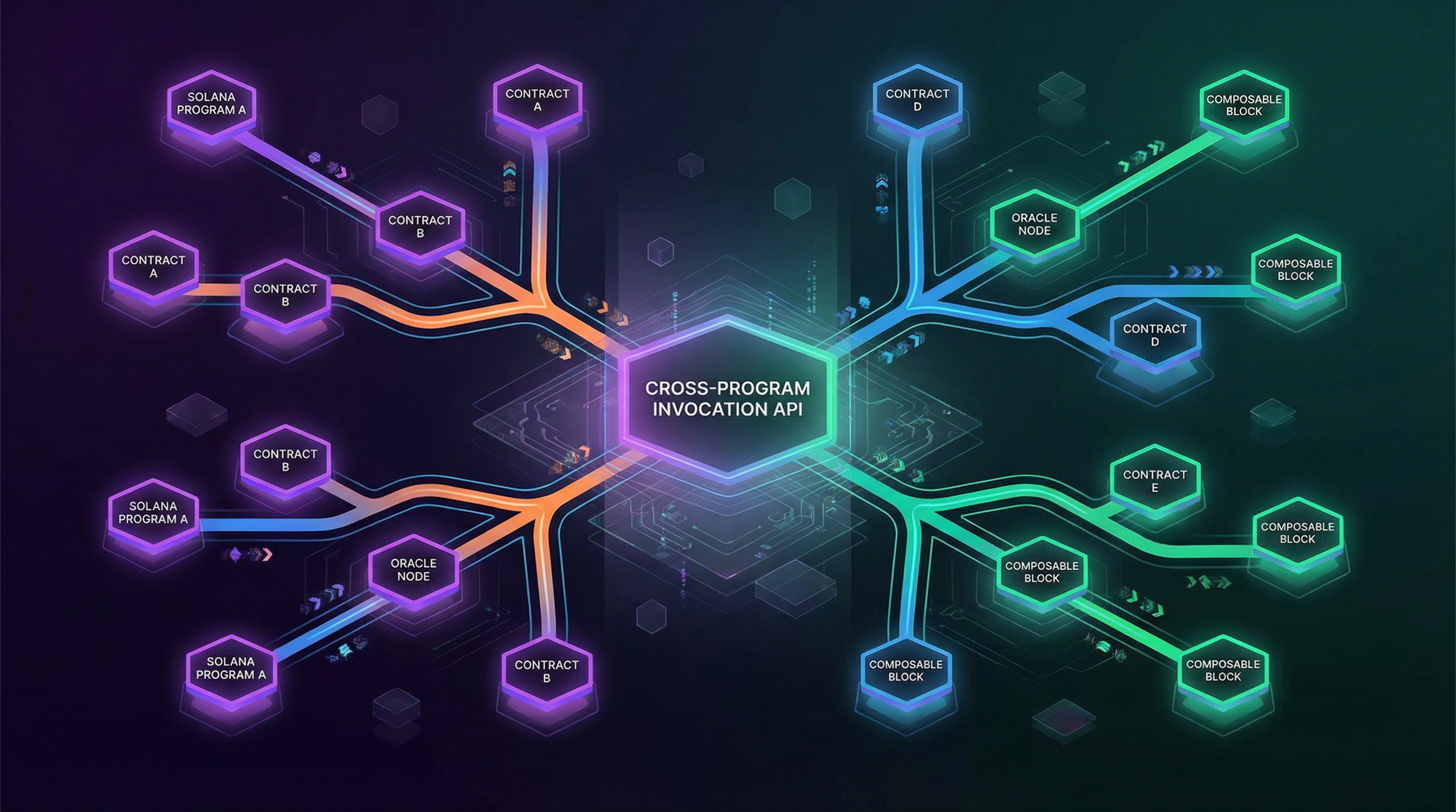
Every blockchain promises "composability"—the ability for different apps to work together seamlessly. But on most chains, this is more marketing than reality. Programs exist in isolated silos, forcing developers to rebuild basic functionality or rely on complex workarounds.
Solana took a different approach. At its core sits a mechanism called Cross-Program Invocation (CPI)—and it's the reason why building on Solana feels less like reinventing the wheel and more like assembling Lego blocks.
What Makes CPI Different
Think of CPI as the nervous system of Solana's application layer. When one program needs functionality from another—say, transferring tokens or minting NFTs—it doesn't copy code or use complex bridges. It simply calls the other program directly, within the same transaction.
Here's the elegant part: CPIs preserve context and permissions. If you sign a transaction authorizing your wallet to interact with a DeFi protocol, that protocol can make CPIs to the token program on your behalf—but only within the scope of what you authorized. The permission chain flows naturally through the stack.
This stands in sharp contrast to Ethereum's contract calls, which require more careful state management and gas estimation across contract boundaries. On Solana, CPIs are a first-class primitive, built into the runtime itself.
The Architecture That Enables Composability
Solana allows programs to nest CPIs up to 4 levels deep (with proposals to increase this to 8). This depth limit isn't arbitrary—it's a carefully chosen balance between composability and performance.
Consider a typical DeFi operation: You swap tokens on a DEX, which calls the token program to transfer your input tokens, calls an oracle for price data, calls the token program again to mint LP tokens, and updates its internal state. Four distinct program interactions, all happening atomically in a single transaction.
This is where Program Derived Addresses (PDAs) become crucial. PDAs allow programs to own and control accounts without private keys. Combined with CPI, this means a lending protocol can hold your collateral in a PDA, and when conditions are met, use a CPI to transfer it—all without any centralized authority holding private keys.
The Real-World Impact
The practical implications of CPI are everywhere in Solana's ecosystem:
**DeFi protocols** don't reimplement token transfers—they call the Token Program via CPI. This means every protocol benefits from the same battle-tested, audited code. When the Token Extensions program added new features, protocols could immediately leverage them through CPIs without updating their core logic.
**NFT marketplaces** use CPIs to Metaplex programs for minting and metadata, to the Token Program for transfers, and to escrow programs for custody. A single "purchase NFT" transaction might involve 5-6 different programs working together seamlessly.
**Gaming projects** compose functionality from multiple specialized programs: inventory management calls asset programs, which call token programs, which trigger reward systems. All in one transaction, all atomic.
The Developer Experience
From a developer perspective, CPI transforms how you think about building. In Anchor (Solana's development framework), calling another program looks like this:
let cpi_ctx = CpiContext::new( token_program.to_account_info(), Transfer { from: user_token_account.to_account_info(), to: vault.to_account_info(), authority: user.to_account_info(), } ); token::transfer(cpi_ctx, amount)?;
You're not copying token transfer logic. You're not wrapping calls in complex interfaces. You're just... calling the token program. It feels like importing a library in traditional software development, except it's happening on-chain, in real-time, with all the security guarantees of the blockchain.
The Compute Cost Trade-off
CPIs aren't free. Each cross-program call consumes compute units—Solana's measure of computational resources. A poorly architected program that makes excessive CPIs can hit compute limits and fail to execute.
This has sparked interesting architectural patterns in the Solana ecosystem. Developers now think carefully about program boundaries, sometimes consolidating related functionality to minimize CPIs, other times splitting programs to enable better composability. It's a balance between performance and modularity.
Recent optimization patterns have emerged: batching CPIs when possible, using "direct account access" for read-only operations, and designing programs to be "CPI-efficient" from the ground up. The 2026 proposal to increase CPI depth from 4 to 8 levels reflects the community's understanding that more complex compositions are valuable, even at the cost of additional compute overhead.
Why This Matters for the Ecosystem
CPI isn't just a technical feature—it's an architectural choice that shapes the entire ecosystem. It's why Solana has such a rich DeFi landscape with protocols that naturally integrate with each other. It's why new token standards can be adopted quickly. It's why building on Solana often means composing existing programs rather than starting from scratch.
The network effect is powerful: every new program with a useful CPI interface becomes a building block that all future programs can leverage. The Token Extensions program, launched recently, immediately became accessible to thousands of existing programs through CPI—no upgrades required.
This is what true composability looks like. Not aspirational roadmap promises, but working code enabling developers to build on each other's work, today, on mainnet, at scale.
The Bottom Line
Cross-Program Invocation is Solana's answer to blockchain composability. While other chains talk about interoperability as a future goal, Solana shipped it as a core primitive from day one.
For developers, CPI means faster development cycles and access to a rich ecosystem of reusable components. For users, it means better products built on battle-tested infrastructure. And for the ecosystem, it means a compounding advantage as each new program multiplies the possibilities for every other program.
In a landscape where most blockchains still struggle with basic contract interactions, Solana's CPI architecture is proof that the right low-level decisions create outsized high-level impact. The programs don't just coexist—they collaborate.