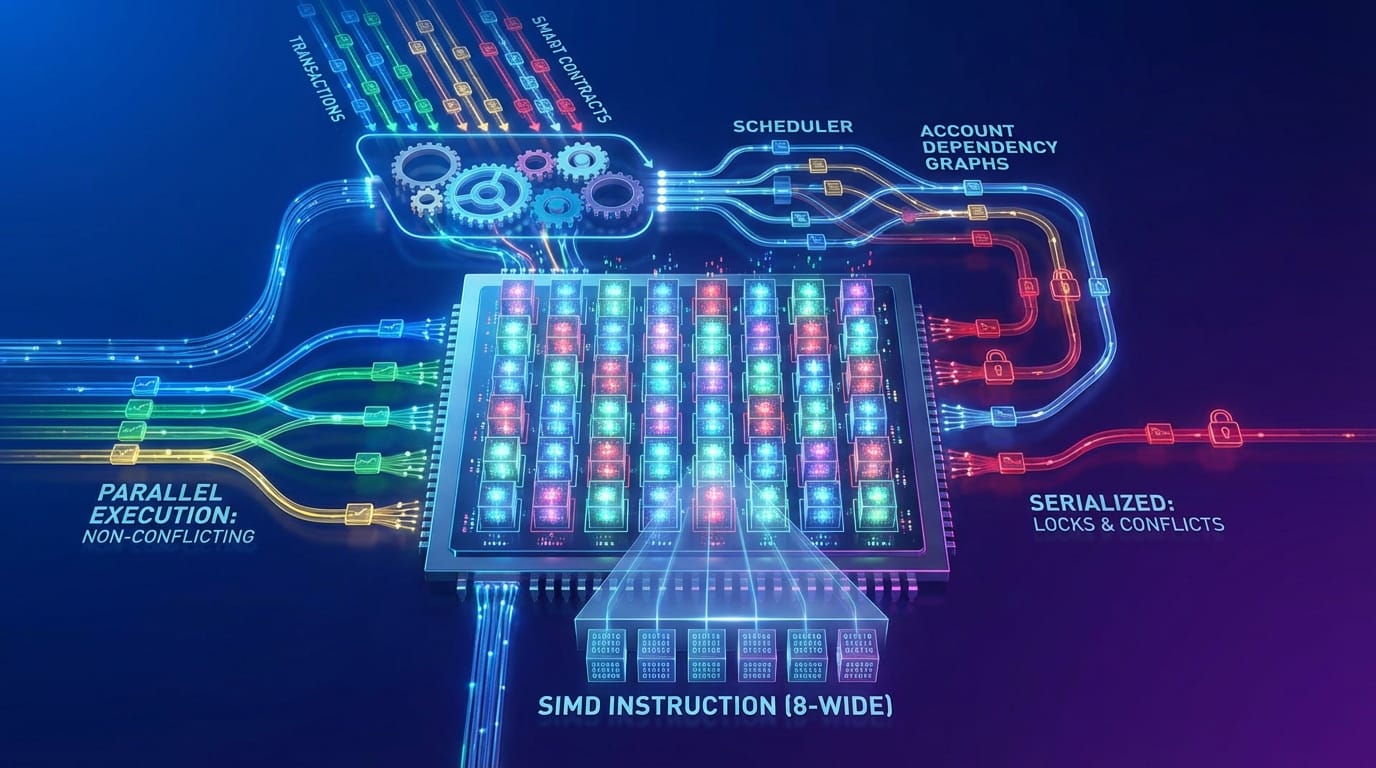
While most blockchain runtimes process smart contracts sequentially—one transaction at a time—Solana's Sealevel runtime takes a radically different approach. By requiring transactions to explicitly declare which accounts they'll read and write, Sealevel can identify non-conflicting transactions and execute them in parallel across thousands of cores. This architectural innovation is fundamental to Solana's ability to process over 50,000 transactions per second while maintaining sub-second finality.
The Sequential Bottleneck in Traditional Blockchains
Ethereum's EVM and most smart contract platforms execute transactions sequentially. When a block contains 200 transactions, the runtime must process them one by one, waiting for each to complete before starting the next. This approach is safe—it prevents race conditions and ensures consistency—but it severely limits throughput.
Even if you have a 128-core processor, traditional blockchain runtimes can only utilize a single core for smart contract execution. The other 127 cores sit idle, wasting computational capacity. As transaction demand grows, sequential processing becomes an insurmountable bottleneck—you can't simply "add more cores" to speed things up.
Sealevel's Parallel Execution Model
Sealevel solves this by requiring every transaction to declare upfront which accounts it will read from and write to. This transaction description makes it possible to analyze dependencies before execution begins. If Transaction A modifies Account X and Transaction B modifies Account Y, Sealevel recognizes they don't conflict and can run simultaneously on different CPU cores.
The runtime uses a scheduler that:
- Analyzes account dependencies across all transactions in the block
- Groups non-conflicting transactions into batches that can execute in parallel
- Distributes execution across all available CPU cores
- Ensures serial ordering for conflicting transactions that touch the same accounts
A block with 1,000 DEX swaps, 500 NFT mints, and 300 token transfers can have hundreds of transactions executing simultaneously—limited only by actual conflicts, not by runtime architecture.
SIMD Optimization Within Transactions
Sealevel takes parallelization a step further with Single Instruction, Multiple Data (SIMD) operations. Modern CPUs have vector instruction sets (like AVX-512) that can perform the same operation on multiple data points simultaneously. Sealevel's BPF JIT compiler optimizes smart contract bytecode to leverage these instructions.
For example, when verifying Ed25519 signatures—a common operation in Solana programs—SIMD allows the runtime to verify 8 signatures in parallel within a single CPU instruction. When processing a batch transaction that transfers tokens to 100 recipients, SIMD can apply balance updates in vectorized chunks rather than one-by-one loops.
This means Sealevel achieves parallelism at two levels: across different transactions using multiple cores, and within individual transactions using SIMD vectorization. Both contribute to Solana's exceptional throughput.
Account Locking and Conflict Resolution
When transactions do conflict—for instance, multiple transactions trying to modify the same liquidity pool—Sealevel uses read-write locks to maintain consistency. The scheduler identifies that these transactions access overlapping accounts and serializes them automatically.
Read-only account access doesn't create conflicts—hundreds of transactions can read the same account simultaneously. Only write access requires exclusive locks. This distinction allows Sealevel to maximize parallelism for read-heavy workloads like price oracle queries or balance checks.
The upfront declaration requirement also enables early failure detection. If a transaction declares it will write to Account X but that account doesn't exist or is locked, Sealevel can reject it immediately without wasting execution resources.
Real-World Performance Impact
During peak NFT mints or DEX trading activity, Sealevel's parallel execution becomes critically important. A typical Solana validator with 128 CPU cores can process vastly more transactions per second than a sequential runtime, even with identical core clock speeds.
Benchmark testing shows that Sealevel can execute 50,000+ simple token transfers per second on appropriate hardware. More complex smart contracts—like AMM swaps or compressed NFT mints—still benefit from parallelization when transaction batches contain diverse account access patterns.
The performance difference becomes dramatic during network congestion. While sequential runtimes hit a hard ceiling, Sealevel scales with available hardware. Validators with higher core counts can process proportionally more non-conflicting transactions, making hardware upgrades directly beneficial to network capacity.
Developer Implications
For developers, Sealevel's parallel execution model has important implications. Programs must be designed with explicit account declarations, which requires thinking about state access patterns upfront. This is more restrictive than EVM's implicit state access but enables much higher throughput.
Smart contract architectures that minimize shared state bottlenecks benefit most from Sealevel. For example, designing a DEX with multiple independent liquidity pools rather than a single global pool allows more transactions to execute in parallel. Similarly, separating user account data from program logic enables better parallelization during high activity periods.
Understanding Sealevel's parallelism also helps optimize transaction construction. Wallets and applications can batch non-conflicting operations into single transactions, knowing they'll execute efficiently. Conversely, when submitting many transactions simultaneously, spreading them across different accounts improves the chance of parallel execution.
The Future of Parallel Execution
Sealevel represents a fundamental rethinking of blockchain runtime architecture. While sequential execution is simpler to reason about and implement, parallel execution is essential for blockchains aiming to support web-scale applications with millions of users.
Future enhancements to Sealevel focus on even smarter scheduling algorithms that can predict account conflicts with higher accuracy, reducing unnecessary serialization. Research into speculative execution—where the runtime tries optimistic parallel execution and rolls back conflicts—could further improve throughput for unpredictable workloads.
As CPU architectures continue evolving toward higher core counts and more sophisticated vector instruction sets, Sealevel's design positions Solana to benefit automatically. The runtime scales with hardware improvements rather than fighting against them—a crucial advantage as the network grows toward processing hundreds of thousands of transactions per second.