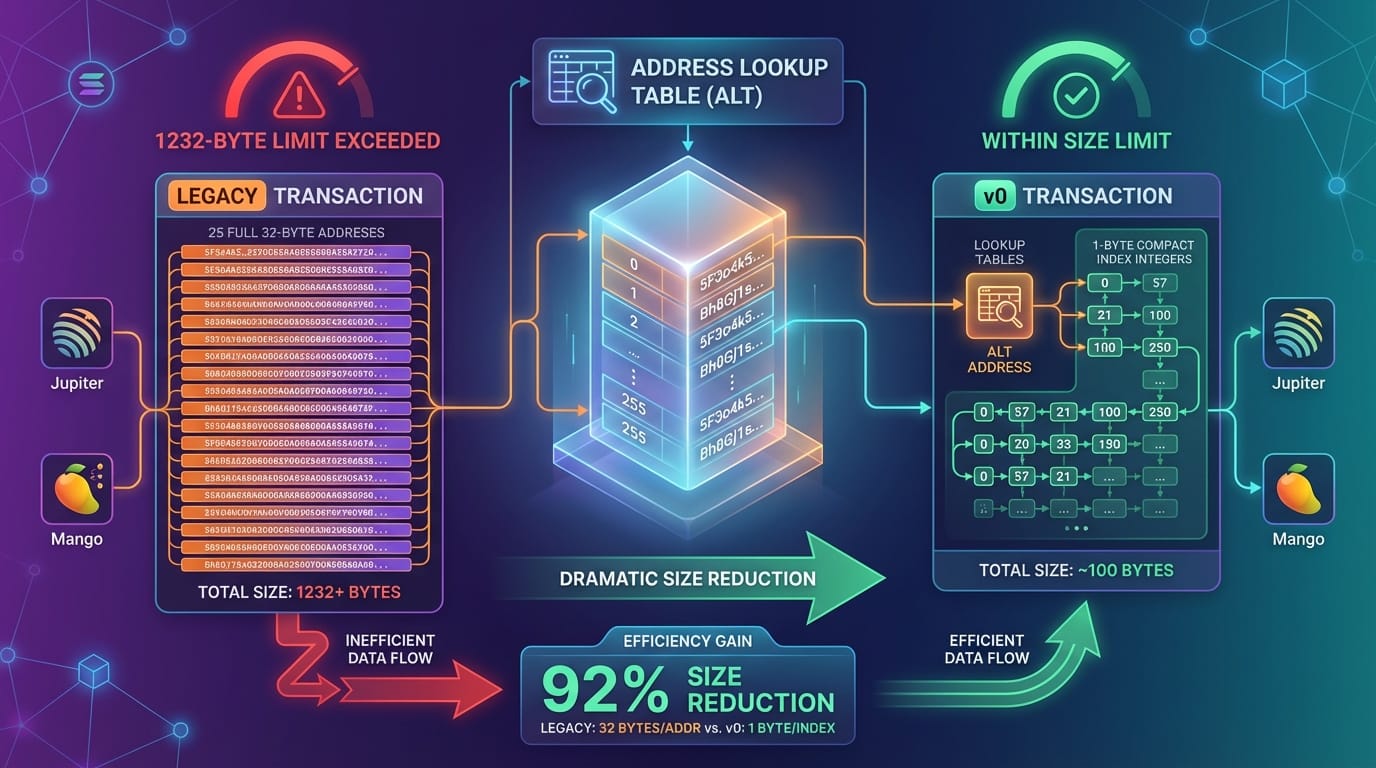
Versioned Transactions on Solana: Address Lookup Tables and the Future of Composability
As Solana's DeFi ecosystem exploded in 2021-2022, developers hit a hard wall: the 1232-byte transaction size limit. Complex protocols like Jupiter aggregator routes or automated strategies involving flash loans, swaps, and lending—often requiring 30+ accounts—couldn't fit in a single transaction. The solution arrived in early 2022 with versioned transactions and Address Lookup Tables (ALTs)—a breakthrough that fundamentally changed what's possible in Solana transactions.
The Problem: Transaction Size Limits Hit DeFi Composability
Every Solana transaction has a maximum size of 1232 bytes. In legacy transactions (v0), each account address consumes 32 bytes. A typical DeFi operation might need:
- User wallet account
- Token accounts (2-4 for swaps)
- Program accounts (AMM program, token program)
- Pool accounts (liquidity pools, vaults)
- Oracle accounts (price feeds)
With 32 bytes per account, you'd hit the limit around 25-30 accounts. Multi-hop swaps (SOL → USDC → ETH → BTC) or vault strategies composing multiple protocols became impossible. Developers had to split operations across multiple transactions, adding latency, complexity, and MEV risk.
The Solution: Versioned Transactions (v0) + Address Lookup Tables
Introduced in March 2022, versioned transactions added a version field to distinguish new transaction formats from legacy ones. The first new version (v0) introduced Address Lookup Tables (ALTs)—on-chain accounts that store arrays of addresses.
How Address Lookup Tables Work
Instead of embedding full 32-byte addresses in your transaction, you:
- Create an ALT account containing frequently-used addresses (e.g., token programs, pool accounts, oracle addresses)
- Reference the ALT in your transaction (32 bytes for the ALT address)
- Use 1-byte indices to point to accounts in the ALT instead of full addresses
Size savings:
- Legacy transaction: 20 accounts × 32 bytes = 640 bytes
- v0 with ALT: 1 ALT address (32 bytes) + 20 indices (20 bytes) = 52 bytes
92% size reduction for those 20 accounts. Transactions that previously couldn't fit now have room for 50+ accounts with multiple ALTs.
ALT Lifecycle and Management
Creating and managing ALTs involves several steps:
- Creation: Call createLookupTable with a recent slot and authority (your wallet)
- Extension: Use extendLookupTable to add addresses (up to 256 addresses per ALT)
- Activation: ALTs have a 1-slot delay before they're usable (prevents race conditions)
- Deactivation & Closure: Deactivate, wait 512 slots (~5 minutes), then close to reclaim rent
ALTs are owned by the Address Lookup Table Program (AddressLookupTab1e1111111111111111111111111) and cost rent based on the number of addresses stored.
Real-World Impact: Jupiter, Mango, and Beyond
Versioned transactions transformed what's possible on Solana:
- Jupiter Aggregator: Can now route through 6+ pools in a single transaction, optimizing for best price across Orca, Raydium, Serum, Phoenix, and other DEXs simultaneously
- Mango Markets v4: Supports 20+ collateral types and oracle feeds in a single liquidation transaction
- Yield Aggregators: Protocols like Francium and Tulip can rebalance vaults across multiple lending protocols and farms in one atomic operation
- Flash Loan Strategies: Arbitrage bots can now execute: borrow flash loan → swap on DEX A → swap on DEX B → swap on DEX C → repay loan, all in one transaction
The adoption was rapid: by Q3 2022, over 40% of mainnet transactions used v0 format. Major protocols maintain shared ALTs with common addresses (token programs, system programs, rent sysvar) that everyone can reference.
Implementation Example: Using ALTs in JavaScript
Here's how to create and use an ALT with @solana/web3.js: